phpwarden finds and contains PHP vulnerabilities across your engine, Composer dependencies and WordPress — ranked by real-world exploitation (CISA KEV + EPSS), not just CVSS. Also scans your own code, checks the live site from outside, and blocks exploits of what a site runs, inside PHP. Free, offline, open data.
Every known PHP vulnerability, one dot each: 5,391 rated high or critical, 54 actually exploited. 52 seconds.
Sign up, scan a client's WordPress site, fix the exploited plugin and hand over the report. Recorded live, nothing staged.
Paste your composer.lock (or just enter a PHP version) and get a real,
exploitation-ranked scan from phpwarden's open feed. Nothing is stored. Or browse every advisory.
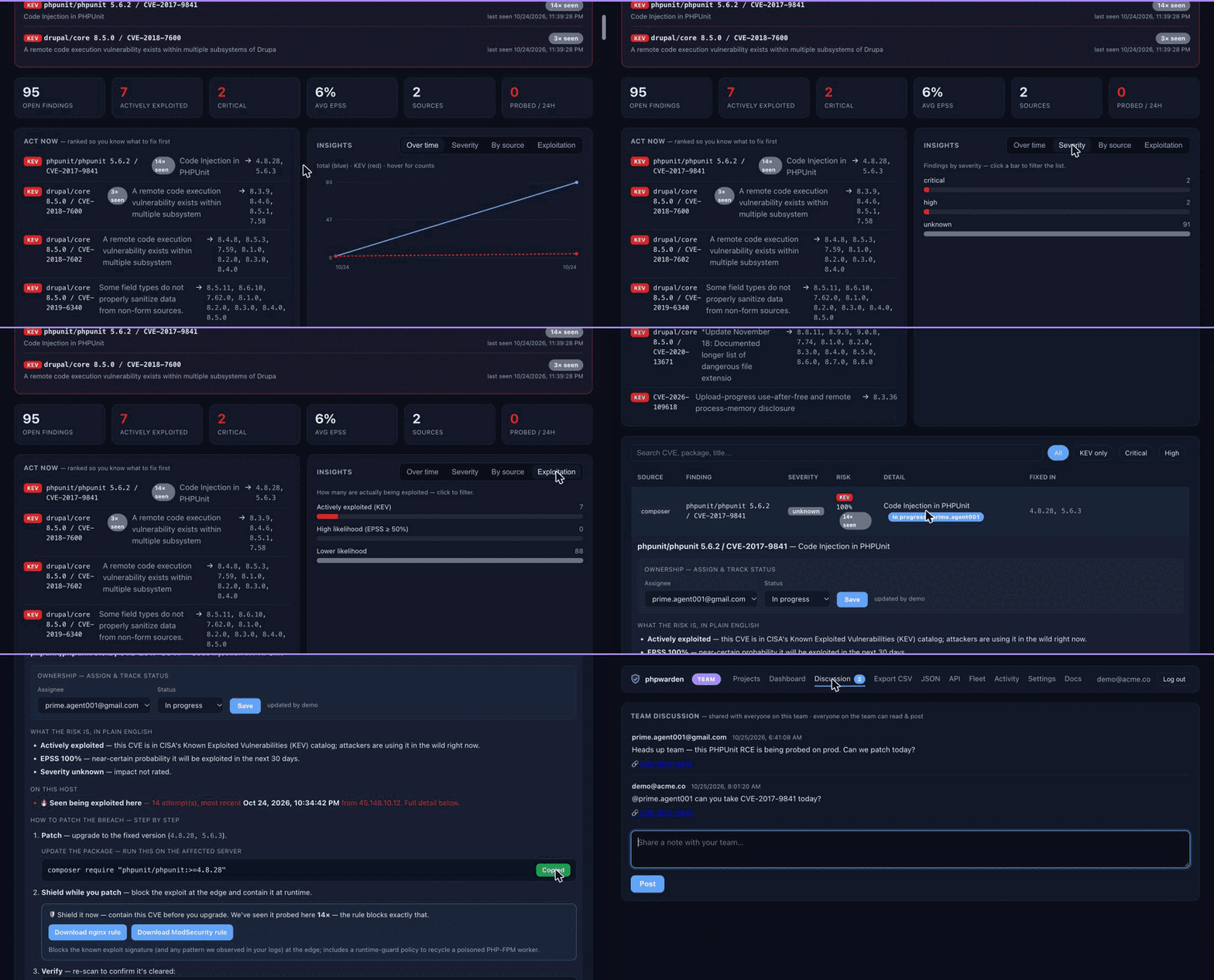
Real output — the dashboard that ranks your fleet by exploitation, and the guard that contains an attack at the FPM layer.
A clear status and an act-now queue ranked by KEV + EPSS, with interactive insights. Free includes one project; Pro unlocks:
composer / wp update command for any finding — ready to paste on the server.
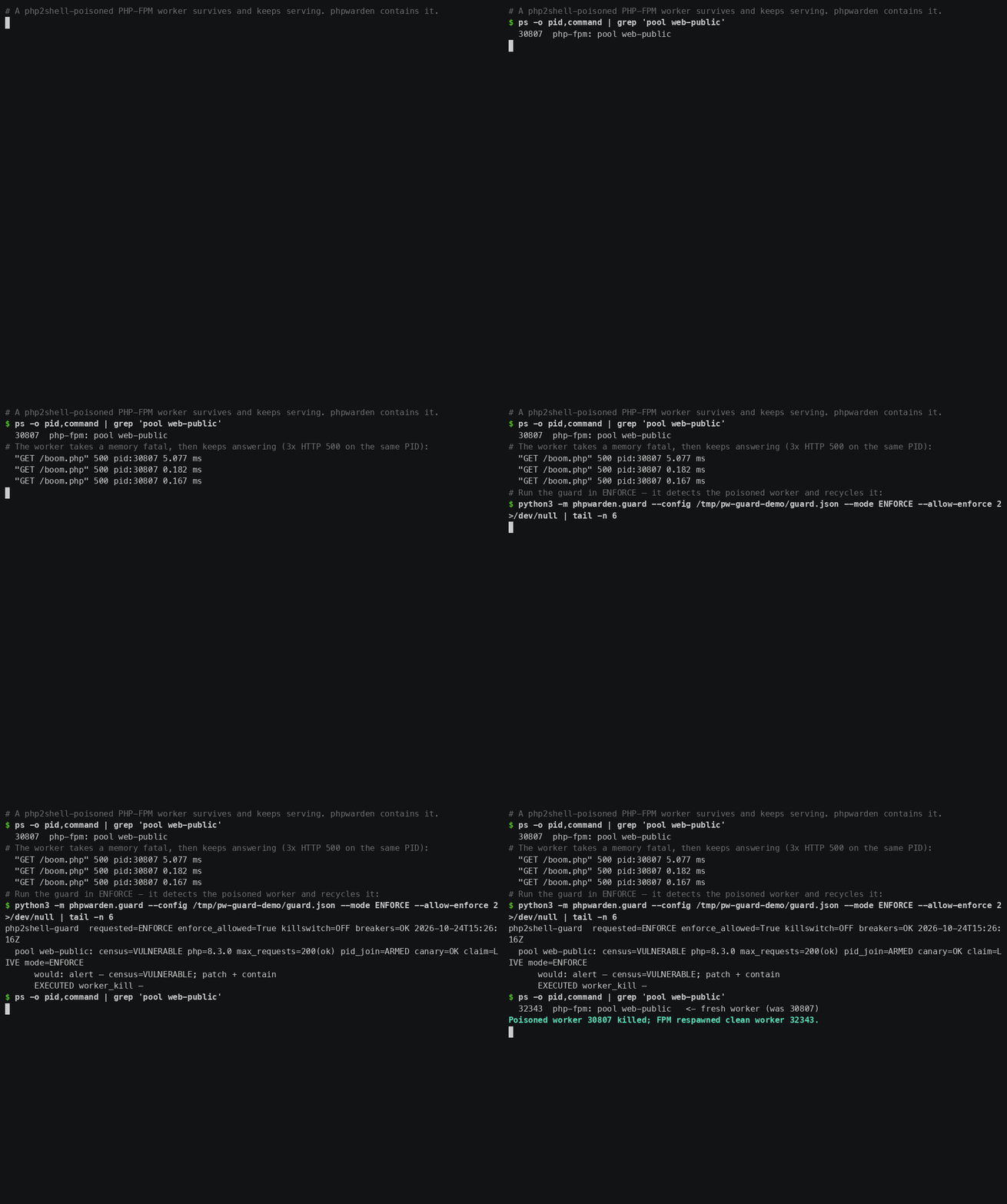
Detects a poisoned, still-serving PHP-FPM worker from the logs and recycles it — live.
Most tools cover one slice. phpwarden covers dependencies, WordPress, your own code, the live site from outside, detection and live containment.
Findings rank by CISA KEV and FIRST EPSS — "being attacked now" floats to the top, ahead of merely high CVSS.
PHP engine CVEs, ~8,800 Composer and ~12,300 WordPress plugin advisories — from open data, bundled and offline. Browse the advisory database →
The guard daemon watches PHP-FPM and kills a poisoned worker before it serves a second request. We know of no other PHP scanner that does this.
See a client site the way an attacker does: exposed .env and .git, debug pages left open, and the versions it gives away. Read-only. The full check runs only on sites you've proven are yours; anything else gets a homepage-only look.
phpwarden code parses the project, resolves types and Composer autoloading, and follows request data across files to SQL, shell, unserialize and includes. Knows Laravel, Symfony and WordPress: open routes, mass assignment, raw Blade and Twig. In our published comparison it found more than Semgrep, Psalm and Snyk Code on the same pinned apps, with far fewer false alarms on clean framework code.
phpwarden assess combines installed versions, your code, the live site and your access log: "exploited, reachable, visible from outside, being probed". Then proves the fix.
One PHP file loaded before your app blocks exploits of the exploited vulnerabilities this site has, at their entry points. Logs first, blocks only what you promote, fails open. Plus alerts and ModSecurity/nginx rules.
GitHub Action, GitLab and Bitbucket templates, SARIF for code-scanning tabs, and a CI gate on "exploited" rather than on every CVSS 7.
Open engine, open data, zero third-party JavaScript in the UI. Exploited CVEs in the feed within 24 hours, with the evidence public.
composer require --dev phpwarden/phpwarden for PHP projects, or the single-file phpwarden.pyz — nothing to install. Zero dependencies. (On PyPI too: pipx install phpwarden.) WordPress site? Install the phpwarden plugin from WordPress.org: Plugins → Add New, search phpwarden. Watch how (2 min).
phpwarden scan --report-to… in CI or cron posts results to your dashboard.
See findings ranked by exploitation, with exact fix versions, history and alerts.
We don't replace your WAF or CNAPP — we own the PHP layer they underserve.
| Capability | phpwarden | Snyk | Patchstack / Wordfence |
|---|---|---|---|
| ▸Exploitation-first ranking (KEV + EPSS) | Yes, free | Blended score, no KEV-first sort | Patchstack: KEV only · Wordfence: no |
| We rank findings by whether they're actually being attacked — CISA's Known Exploited Vulnerabilities (KEV) catalog and FIRST's EPSS probability — not just a static CVSS number. A "critical" CVSS with no real-world exploitation drops below a "high" that's being exploited today, so you fix what matters first. Ranking is free for everyone, not held back for a paid tier. As of 2026-11-12, by their public docs: Snyk folds exploit data into a proprietary score; Patchstack prioritises by KEV without EPSS; Wordfence ranks by CVSS severity. Check their docs for changes. | |||
| ▸Composer dependency CVEs | Yes | Yes | No |
Point phpwarden at a composer.lock and it flags vulnerable PHP packages against ~8,800 Composer advisories (FriendsOfPHP / OSV), with the exact fixed version to upgrade to. WordPress-only tools don't cover your framework and library dependencies. | |||
| ▸WordPress core, plugin and theme CVEs | Yes | No | Yes |
| Scan a WordPress install — core, plugins and themes — against ~12,300 advisories. Snyk's dependency scanning does not cover WordPress plugins and themes, by its public docs (2026-11-12), and most dependency scanners don't either; phpwarden covers it alongside your Composer deps and PHP engine in one report. | |||
| ▸Scan of your own PHP code | Yes: whole program, Laravel/Symfony/WordPress-aware | Yes (Snyk Code, many languages) | No |
phpwarden code parses every file, models the whole program (types, autoloading, inheritance) and follows request data across files to dangerous calls, with a trace per finding. On the same pinned apps it found 8/8/7 of DVWA's 8 vulnerability types at low/medium/high and all 11 in Mutillidae, against Semgrep's 3/2/3 and 4, Psalm's 5/3/4 and 8 and Snyk Code's 3/2/2 and 4, with 7 high findings on all of WordPress core (Semgrep 173, Psalm 442, Snyk Code 51). The comparison. | |||
| ▸Outside check of a live site you manage | Yes, read-only | Not part of Snyk Open Source; check their docs | Not offered as a read-only outside check; check their docs |
The live check requests a site from outside and reports exposed .env and .git files, debug pages left open and the versions it gives away, matched against the feed. It sends GET and HEAD requests only, and the full check runs only after the site proves it is yours. In the CLI and on the dashboard. How it works. | |||
| ▸Blocks exploits of the vulnerabilities this site has, inside PHP | Yes: rules generated per site, log-only first | Not offered; check their docs | Patchstack: managed virtual patches for WordPress plugins; check their docs |
phpwarden shield writes rules only for exploited vulnerabilities that are installed on that site, scoped to the vulnerable component's entry points, and a PHP file loaded before the app enforces them. It logs until you promote a rule after a 7-day burn-in, fails open on any error and has a kill switch. No match on 14,291 ordinary test requests; about 0.07 ms per request. It is not an edge firewall: no DDoS, bot or TLS handling. How it works. | |||
| ▸PHP-FPM runtime containment | Yes (dry-run on Pro, enforce on Team) | No | No |
| The guard daemon watches PHP-FPM and detects a poisoned worker that's still serving requests (e.g. after a php2shell-style memory attack), then recycles it — before it serves a second request. This is runtime defense, not just scanning. Nothing else in this list does it. | |||
| ▸Offline / open data | Yes | No | No |
| The engine and its vulnerability feed are built on open data (OSV, NVD, FriendsOfPHP, php-src NEWS, CISA KEV, FIRST EPSS) and bundled, so the CLI runs fully offline with zero third-party JavaScript in the UI. No vendor's licensed feed, no phoning home, no lock-in. | |||
| ▸Starting price | Free | From $25/mo (Team) | Patchstack $69/mo for 25 sites · Wordfence $149/site/yr |
| The CLI, the bundled feed and one project dashboard are free forever — no credit card. Paid plans add the maintained feed (rebuilt twice a day), weekly live checks, more projects, history, alerts and team features. Snyk has a free tier limited to 5 projects; Patchstack and Wordfence have free tiers with paid protection. Prices checked 2026-11-12. | |||
Competitor prices are indicative and change; verify on their sites. See detailed, sourced comparisons: vs composer audit, vs Snyk, vs Wordfence CLI, vs Patchstack, vs Aikido, vs Enlightn, vs WPScan, vs Roave Security Advisories · all comparisons.
Free forever for the CLI and one project. Pay to be told without having to look: the twice-daily feed, weekly live checks and alerts. Agencies get client reports, per-site access and a partner API on Team and Agency.
Save 2 months with yearly billing: Pro $390/yr, Team $1,490/yr, Agency $2,990/yr.
Hosting company? Per-server pricing through the WHMCS module, from $15 per server per month. See host pricing.
Managing many client sites, or hosting them? See how Team and Agency work for agencies and hosts, and the client report, roles and partner API docs. Need something else? Email [email protected].
Start free in under a minute — no credit card, works offline.
Start free